
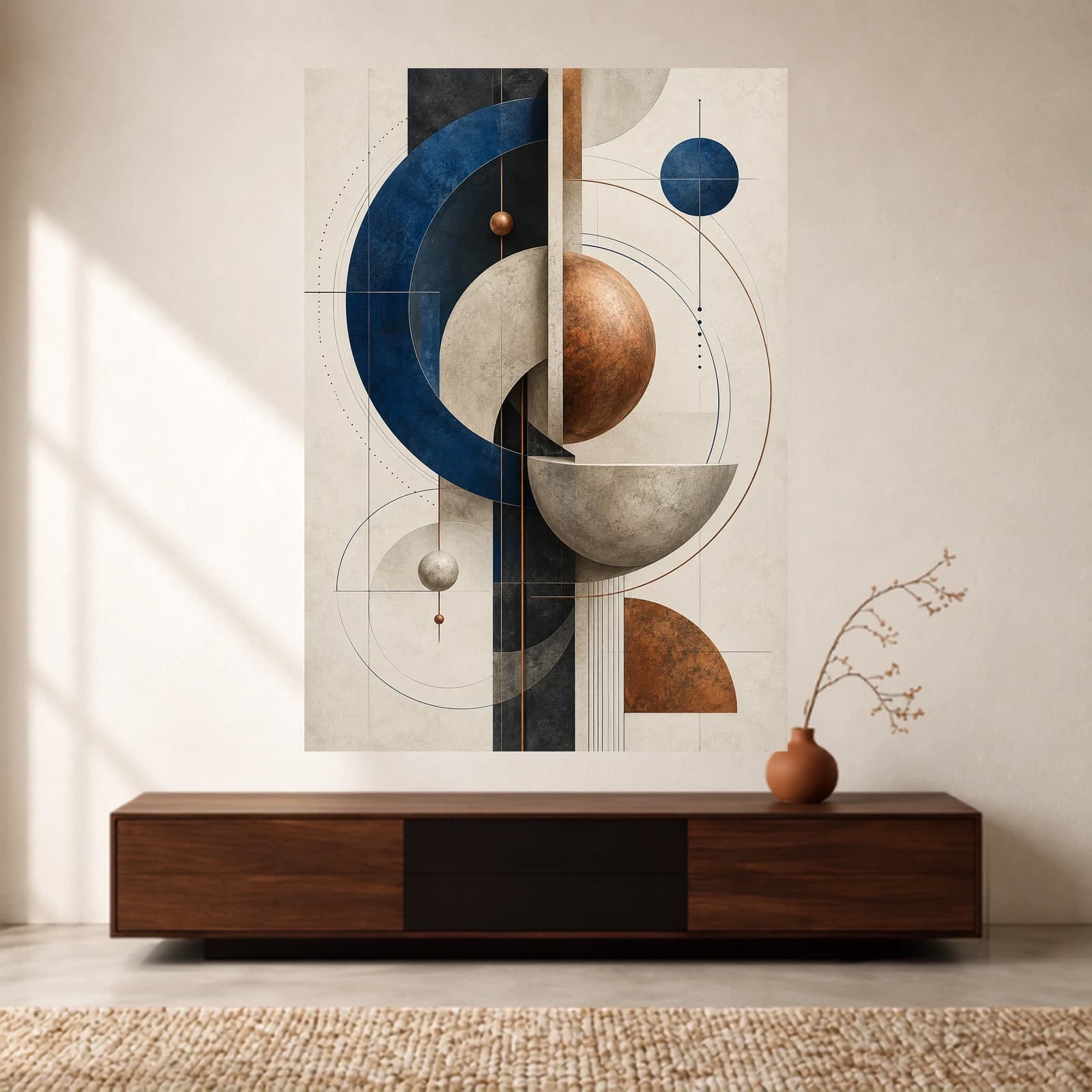
Wall art22 October 20268 min read
Geometric Wall Art Ideas: How to Choose Prints for Your Room
Choose geometric prints by pattern, colour and scale, with practical ideas for living rooms, bedrooms, desks and small gallery walls.
A geometric print can be the detail that brings a room together—or one more pattern competing for attention. The difference usually comes down to three choices: how busy the artwork is, which colours it repeats, and how much space you give it.
Start with the wall you actually want to decorate. Notice the furniture below it, the patterns already in the room and the distance from which you will see the print. Then choose shapes that add something the space needs.
A simple way to choose a geometric print
- Choose the intensity: fewer, larger shapes for a busy room; a more intricate composition where you want a focal point.
- Repeat one colour: borrow a tone from your furniture or textiles, without matching the entire room.
- Test the full footprint: use paper templates for the outside dimensions, including frames and gaps.
Start with the geometric print collection, then use the room examples below to narrow your choice.
What is geometric wall art?
Geometric wall art uses shapes, lines and their arrangement as a major part of the composition. Circles, rectangles, grids, arcs and repeated angles are common examples. MoMA’s geometric abstraction collection offers examples of how artists have explored this approach.
The category is broader than black-and-white grids. A geometric print might combine crisp blocks of colour, overlapping arches or a few carefully spaced circles. Some designs also include a recognisable subject, such as a sun or an architectural opening. You do not need to identify an art movement to choose one you enjoy looking at.
Choose the amount of pattern before the colour
A room with a patterned rug, open shelving and several small objects already contains plenty to look at. Try artwork with fewer shapes, larger areas of colour and some open space around the main forms.
A quieter room can accommodate a more intricate grid or a stronger contrast. Look at the print from the doorway as well as close up: fine details that work on a screen can become difficult to read across a room.
A useful starting point is to give one element the leading role. If the art is bold, keep the objects immediately around it simple. If you want a collection of ceramics or books to remain the focus, choose a print that supports their colours without matching every detail.
Three approaches to try
| Approach | What to look for | Where to start |
|---|---|---|
| Bold and structured | Clear blocks, strong lines or a repeated grid | A simple wall above a desk or console |
| Soft and layered | Arches, rounded forms and a restrained palette | A bedroom corner or living space with curved furniture |
| One colour accent | Mostly neutral shapes with a single stronger colour | A room where you want to repeat one existing accent |
These are styling starting points rather than rules. A rounded composition can work in an angular room precisely because it introduces a different shape.
Geometric wall art above a sofa
Treat the sofa and artwork as one arrangement. Measure the available wall width, then mark out the proposed display using loose paper templates. Include the frame and the gaps between prints, rather than measuring only the printed sheets.
For a room with a cream sofa and navy cushions, try a print that brings those colours together with one warmer tone. Coastal Arches combines navy, terracotta and cream around an architectural opening and a small horizon. It is one way to connect a cool accent with warmer furniture.
If you choose two prints, give them a clear relationship: a shared colour, repeated shape or similar amount of open space. They do not need to be identical. Our guide to artwork above a sofa covers the wider placement decision.
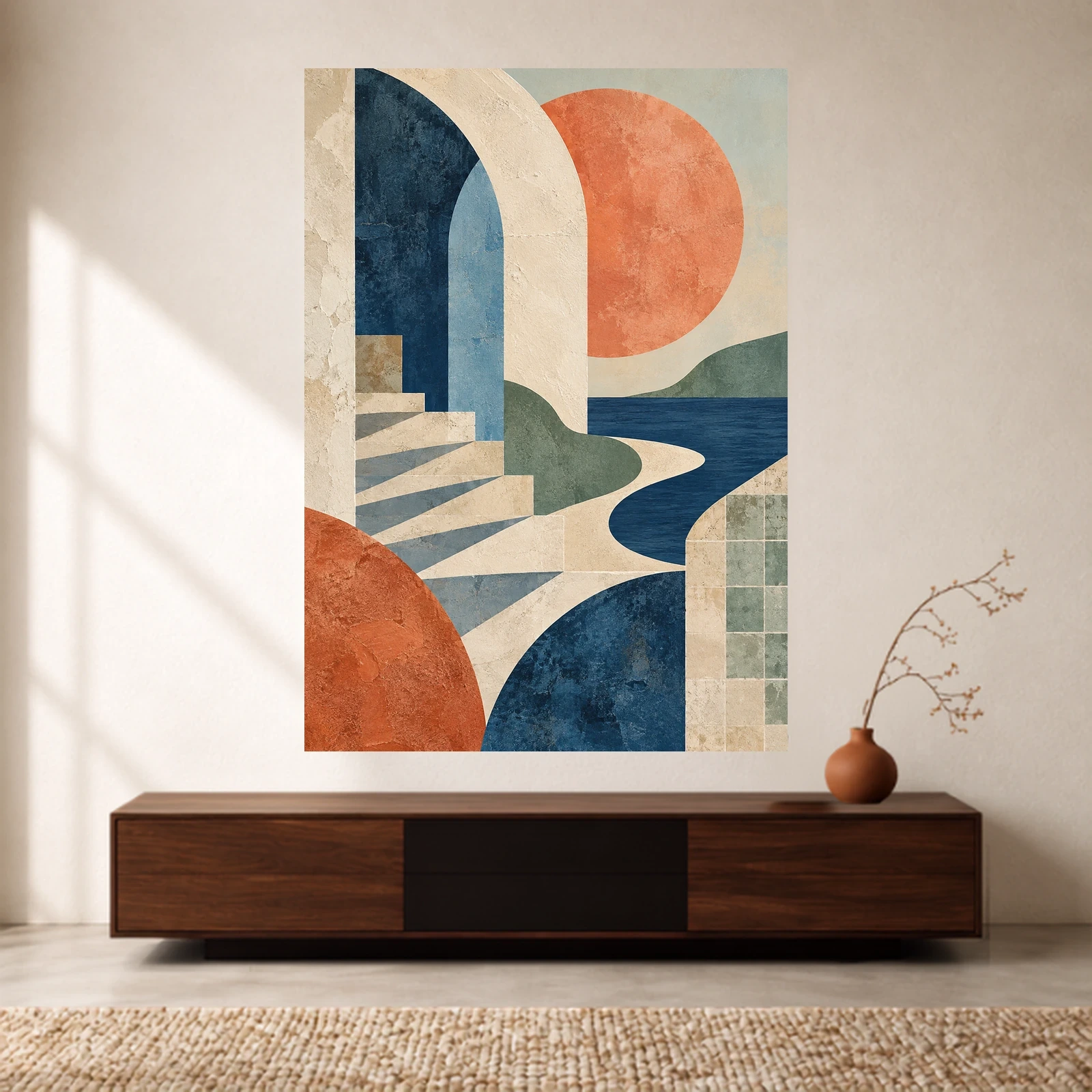
A quieter choice for the bedroom
Decide how much contrast you want to see when you enter the room. A tightly packed black-and-white pattern makes a different statement from a few rounded shapes on a pale background; neither is automatically the right choice for every bedroom.
Try repeating a colour from the bedding or curtains, then compare the artwork beside the wall in daylight and evening light. A colour that looks warm on a phone screen may read differently next to your actual paint. Our wall art colour guide explains how to build a palette around what you already own.
For an alternative to rigid grids, Cobalt Topography uses layered contours with a blue focal point. Its flowing forms offer an abstract option if sharp angles feel too strong for the space. Choose the level of contrast you enjoy seeing in that room.
Add structure to a desk or home office
Check the view with your monitor, lamp and shelves in place. A print that looks balanced on an empty wall can disappear behind equipment once the desk is in use.
Indigo Lattice uses an asymmetrical arrangement of indigo, terracotta, mustard and charcoal. Bauhaus Orbit brings together cobalt circles, terracotta forms and cream planes. Compare the two with your desk accessories: one repeated colour is often enough to establish a connection.
Avoid treating motivational text, shelving, lighting and a large patterned print as four separate focal points. Choose what you want to notice first, then leave space around it.
Choose the print size and presentation together
A4 is 21 × 29.7cm, A3 is 29.7 × 42cm and A2 is 42 × 59.4cm. These measurements describe the print; a surrounding frame makes the complete object larger. Check the selected product's dimensions before planning a tight space. The wall art size guide explains how to compare sizes.
Presentation changes the composition too. A dark frame adds another visible line; a lighter wood finish creates a different boundary between artwork and wall. Where offered, a wooden hanger leaves the sides of the paper exposed instead of surrounding all four edges.
Use your selected market's product options to check the available materials, sizes and presentations. A room photograph may show styling props, so confirm what is included with the option you order. A printed white margin is part of the paper, not a separate framing mount.
Worked example: two A3 prints with a 5cm gap
Two portrait A3 sheets are each 29.7cm wide and 42cm tall. With a 5cm gap between their paper edges, the arrangement is 29.7 + 5 + 29.7 = 64.4cm wide. By comparison, a single portrait A2 sheet is 42cm wide: the pair occupies a wider area even though each individual print is smaller.
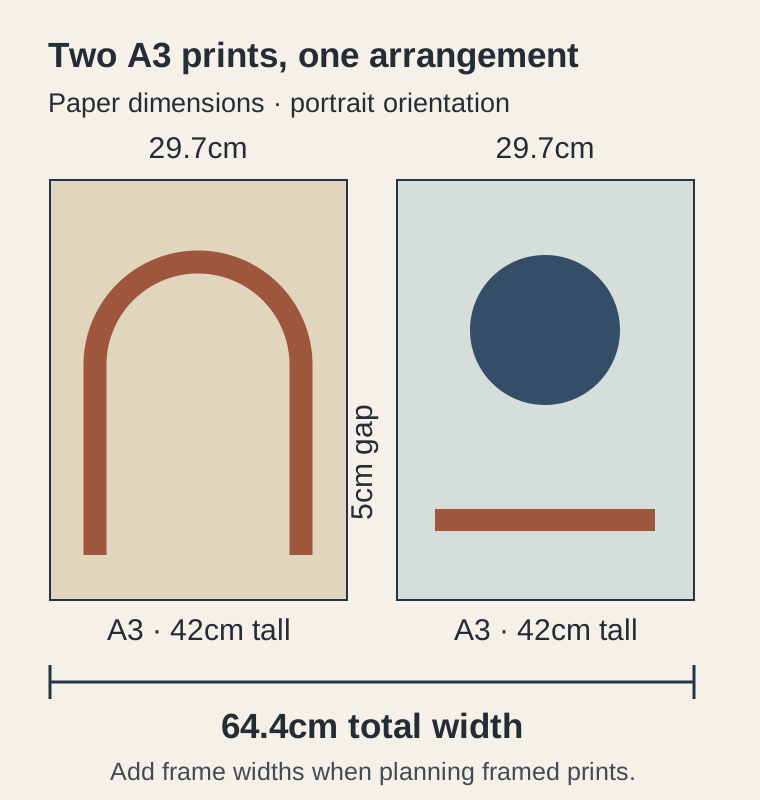
The 5cm gap is an example to test, not a required spacing. Cut two paper templates, move them closer together or farther apart and look from your usual seat before deciding. If you want a 5cm gap between frames, measure between the outside frame edges.
Build a small geometric gallery wall
Start with two or three prints rather than buying enough to fill the entire wall at once. Pick one connection—such as navy, repeated curves or a consistent frame finish—and allow the other details to vary.
Lay the arrangement on a table or floor before hanging. Try changing the gaps and swapping the positions. If each print is intricate, a little more separation may make the individual designs easier to appreciate. Keep the overall arrangement related to the furniture beneath it.
For a mixed display, combine a more structured geometric design with a quieter abstract or botanical print. Repeating a colour can connect them without requiring every picture to use the same subject. For planning an arrangement with different sizes, use our gallery wall planning guide.
Common questions about geometric wall art
Can geometric wall art work in a small room?
Yes. Start with the wall you can comfortably see, then test the complete display size with paper templates. A simple composition can be easier to read among shelves and furniture. A small room does not automatically require the smallest print; viewing distance and available wall space matter too.
Is geometric art the same as abstract art?
The terms overlap. Geometric abstraction builds a composition around shapes and lines, while abstract art also includes looser gestures and organic forms. A geometric-style print can still contain a recognisable sun, staircase or landscape. Choose by the actual composition rather than relying only on a category name.
Should the print match every colour in the room?
No. Repeating one or two existing tones can connect the artwork with the room while leaving room for contrast. Compare the design with your wall colour and the largest nearby furniture or textiles before trying to match small accessories.
Does the artwork come with a frame?
Check the presentation selected on the product page in your region. A paper print, wooden hanger print and framed print are different options, and availability varies by design, size and market. A styled preview alone does not confirm that a frame or accessories are included.
A quick check before you order
- Measure the complete display area, including frames and gaps.
- Compare the artwork with the room's existing patterns and colours.
- Check how the composition reads from your normal viewing distance.
- Confirm your selected size, material, presentation and included hardware.
- Review any crop or printed margins shown in the product preview.
Browse the geometric wall art collection to compare designs. If you already have artwork of your own, explore custom printing and review the file and layout before adding it to your basket.
Next step
Turn the guide into a finished piece.
Use the guide to pick a ready design, or send your own artwork for studio review before production.